
Kirkreport published an interview with me on 17th June 2011. Here is the transcript of same:
I am pleased to present this in-depth Q&A with Pradeep Bonde, a fellow trader who shares his insight with thousands at StockBee.
Pradeep has earned the respect and admiration of many traders with his no nonsense style, past performance as well as dedication to helping other traders achieve more success in the markets. We both hope you find this interview helpful in your journey!
Q&A with Pradeep Bonde
Kirk: Welcome back Pradeep! It is difficult to believe that it has been well over a year since our last interview. Thanks for being here to share some fresh perspectives with us!
Pradeep: Thank you for having me!
Kirk: Let's begin by first talking about what you are seeing in the market. Please provide us an overview of key things on your radar that you are monitoring closely.
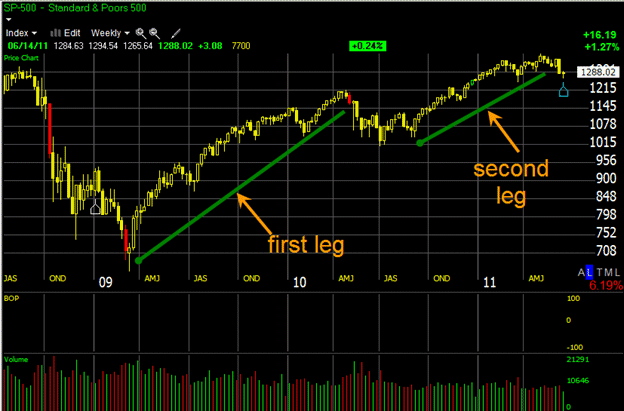
Pradeep: We are in a third year of a big bull move. The move started in March 2009 and has seen 2 big moves.

The first leg was a 70% move from March 2009 to around middle of January 2010. That was followed by a correction and flash crash. Market put in a bottom post flash crash around last week of August 2010 and then the 2nd up leg started.
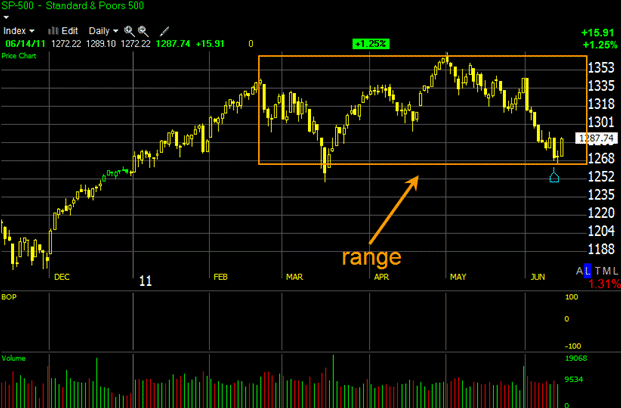
The second up leg was 28% gain and market started correcting in mid February 2011. From February 2011 onwards we are in a range. In recent weeks the range low is being approached.

Last 4 months have seen sharp bounces and sharp corrections. But that is not a surprise. After a big 2 year move a period like this is not an anomaly. After 28% plus gains without correction a correction like this is welcome.
Kirk: What is your "Market Monitor" currently suggesting? And, as a result would you say you are bullish, bearish, neutral or just opportunistic?
Pradeep: The Market Monitor is currently in bearish mode. From around December of 2010 we have seen rallies on progressively lower breadth.
As of now we have not reached extreme bearish readings on Market Monitor. Extreme bearish readings on MM are bullish. As a result at this stage I am in bearish camp and waiting for a bullish breadth thrust to get back in the market.
Kirk: What is your opinion regarding the sector rotation into so-called safety stocks or defensive sectors?
Pradeep: After a 28% rally from September 2010 to February 2011 most leading stocks were extended. Many of them were rallying for last 2 years or so. Many were in 3rd or 4th stage of their rally. A correction was a high probability event due to that and during such correction a flight to defensive stocks is not something that worries me.
The overall economy has also hit a bit of soft patch and a wall of worry is building. That is also leading to sentiments becoming bearish. That sets us up for a second half rally.
Kirk: Many traders have shifted to trading both commodities and currencies. What's your personal take on this?
Pradeep: I have always said that if I had to start trading all over again I would not trade stocks but would trade currencies or commodities. Having spent 12 years plus researching stock trading methods and perfecting them and having very good success, it is now difficult to walk away from it all and start all over.
Commodities and currencies have obvious advantage of leverage. Besides that you are dealing with a small number of markets. Commodities and currencies also perform very well on momentum based methods.
I would advise anyone just starting out to explore the two before committing to stocks. Personally I have set aside a small account to trade commodities and currencies and slowly working on developing and perfecting methods for them.
But stocks remain my focus and that is where I have very high confidence and proven methods.
Kirk: Do you utilize option strategies?
Pradeep: No. In the initial years I spent a lot of time on option strategies but abandoned those efforts to focus on growth and momentum investing.
Kirk: What's the primary focus of your trading now? Also, do you trade ETFs?
Pradeep: My primary focus is growth and momentum stocks. Within that I focus on breakouts. My swing trading effort focuses on finding swings of a few days to weeks. I am primarily a reactive swing trader. I wait for market or stock to confirm a momentum phase and after that look for buying a breakout once the stock has had a 10 to 20 days correction or sideways move.
Under a right kind of circumstances growth and momentum stocks offer very good risk reward for buying breakouts. The trick is to wait for those periods or setups. We had a big debate on buying breakout sometime back on a member's site. Many are very uncomfortable buying breakouts. They like pullbacks. One of the members made a very good observation - a good stock should never offer you a pullback opportunity.
I am not dogmatic about buying breakout. I know people who only buy pullbacks. There are many things that work in the markets, you have to find what works for you.
I do not trade ETFs and my logic regarding this is clear - stocks make bigger moves than ETFs. The biggest 100 or 300 movers in market in any given period will be individual stocks. Yes there are complexities involved in trading stocks and you are exposed to news risk in stocks, but the big opportunity in the market is in stocks.
But I have nothing against those who trade ETFs. They are good vehicle for many kinds of investors and short term traders.
Kirk: What kinds of trades and setups are finding most profitable in this environment?
Pradeep: This market has not been very favorable to trading breakouts currently. This is more a pullback or exhaustion setup kind of market.
Pullbacks to support and MA have worked in this market recently. Exhaustion setups are best setups in this market currently.
Personally I have been in cash for some time as I do not see the kind of setups I look for.
I trade primarily two kinds of setups. A breakout on high momentum stock and the second setup I trade is Episodic Pivots. Episodic Pivots is a news or catalyst based setup.
When a company announces surprisingly good or bad news the market reacts to it. Because markets are not efficient the move does not end in a day. The stock continues to go up or down for weeks or months post such big news. Earnings is obviously one such catalyst. But many other catalyst can lead to similar moves. Episodic Pivots offers you an entry in to move right at beginning of such move.
Kirk: If you will, please take us through one of the more recent and interesting trades from beginning to end.
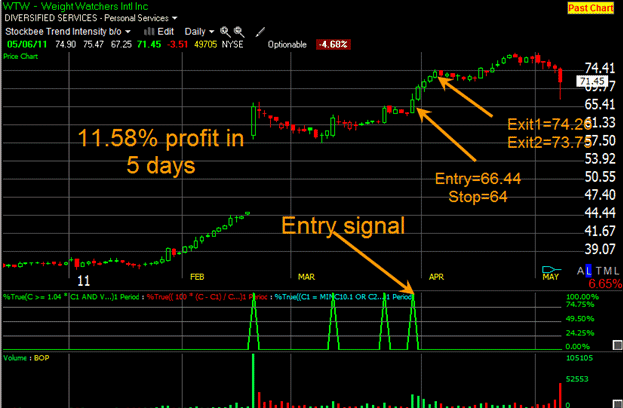
Pradeep: Weight Watchers showed up on my Stockbee Trend Intensity Breakout scan on March 30th 2011. It was making a new high on good volume. Prior to breakout stock had a 4 day consolidation. Recent earnings on the stock were a big surprise. The stock had satisfied my minimum momentum criteria.
I entered the trade at the price of 66.44. In next 4 days it went up by around 1%. I sold half my position around 74. 26 and moved stop on rest to 73.75 to lock in profit and got stopped out.
The chart below shows the trade:

Kirk: Care to share another one? Perhaps a trade that didn't work the way you planned.
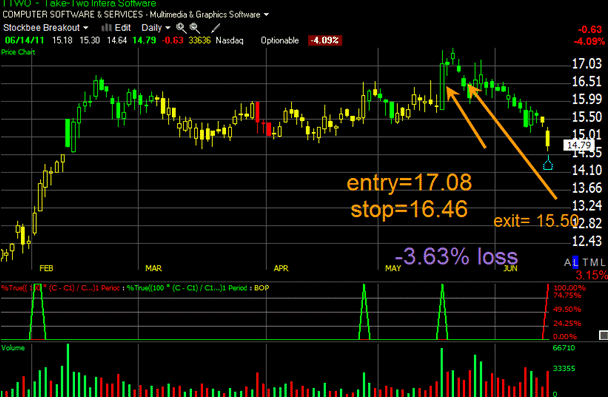
Pradeep: TTWO is an example of failed trade. It shows the importance of trading in the right market environment. Under different market conditions the trade might have worked.

I exited the trade before it hit stop as overall market started showing weakness.
Breakouts fail during certain market phases. Even the best looking breakout with catalyst does not work in bearish phases.
Kirk: How have you been adjusting to the program influences many of us see in the market?
Pradeep: I am not really bothered by programs. I do not trade on intraday time frame. For the momentum stocks I select the program trading does not really affect them. If a stock has extra ordinary momentum in my experience other things don't matter. I am constantly looking for stocks that have above average momentum. These stocks during that phase have significant demand supply imbalance and so they go up or down. Programs don't really affect such stocks much.
In fact programs have magnified momentum moves and momentum moves tend to overshoot in this market as programs that target momentum stocks pile on. A stock that would make 6% move in few days now makes 10% plus move in same time period.
Kirk: That's an interesting observation and confirms something I'm seeing as well. What chart time frames do you view in your technical analysis?
Pradeep: I have not looked at an intraday chart in last 5 years or so. Everything I do is based on daily or weekly charts.
The most important thing I look for any stocks chart is relative linearity. I always look for stocks that are trending smoothly. I pass on volatile stocks that jump all over the place. Stocks with relative linearity have active buyers support and have higher likelihood of continuing their smooth moves. Any stocks that makes 100 % plus move in six month or less will show you that kind of linearity. These kinds of stocks have very orderly corrections and trade very logically. Buyers are continuously supporting such stocks and this constant demand results in a very smooth uptrend with shallow pullbacks.

VRUS is a good example of stock with very high relative linearity currently. It is up 158% in last six months.
Stocks like VRUS are the kind of stocks ideal for swing trading. They allow you to put logical and close stops and make smooth moves.
One of the easiest ways to find stocks with relative linearity is by eyeballing top 300 or so stocks by 6 month or 3 month momentum. There is also a mathematical way to find stocks with relative linearity.
One of the ways to find relative linearity is by using Kaufman's Efficiency Ratio or Fractal Efficiency ratio. The Fractal Efficiency Ratio is described in detail in New Trading Systems and Methods by Perry Kaufman.
Fractal Efficiency ratio is derived by dividing the net change in price movement over n periods by the sum of all component moves, taken as positive numbers, over the same n periods. If the ratio approaches the value 1, then the movement is smooth, if the ratio approaches 0, then there is great inefficiency or chaos. So fractal efficiency basically is a measure of relative market speed to volatility, and can be used as a trading filter to avoid choppy or flat stocks.
To understand this better let's look at a stock price move for 60 days. Stock A makes 60 point move in 60 days. Each day the stock moves up exactly by 1 dollar. This would give an efficiency ratio of 1. Now say for stock B, it also moved 60 points in 60 days, but with higher volatility, some days up 3 points, some days down 2 points. The efficiency ratio would be lower as the denominator in the ratio will be large.
Now if you want to calculate the efficiency ratio in Telechart, you can try this modified scan for 60 days.
60 Day Efficiency Ratio
(C - C60) / (ABS(C - C1) + ABS(C1 - C2) + ABS(C2 - C3) + ABS(C3 - C4) + ABS(C4 - C5) + ABS(C5 - C6) + ABS(C6 - C7) + ABS(C7 - C8) + ABS(C8 - C9) + ABS(C9 - C10) + ABS(C10 - C11) + ABS(C11 - C12) + ABS(C12 - C13) + ABS(C13 - C14) + ABS(C14 - C15) + ABS(C15 - C16) + ABS(C16 - C17) + ABS(C17 - C18) + ABS(C18 - C19) + ABS(C19 - C20) + ABS(C20 - C21) + ABS(C21 - C22) + ABS(C22 - C23) + ABS(C23 - C24) + ABS(C24 - C25) + ABS(C25 - C26) + ABS(C26 - C27) + ABS(C27 - C28) + ABS(C28 - C29) + ABS(C29 - C30) + ABS(C30 - C31) + ABS(C31 - C32) + ABS(C32 - C33) + ABS(C33 - C34) + ABS(C34 - C35) + ABS(C35 - C36) + ABS(C36 - C37) + ABS(C37 - C38) + ABS(C38 - C39) + ABS(C39 - C40) + ABS(C40 - C41) + ABS(C41 - C42) + ABS(C42 - C43) + ABS(C43 - C44) + ABS(C44 - C45) + ABS(C45 - C46) + ABS(C46 - C47) + ABS(C47 - C48) + ABS(C48 - C49) + ABS(C49 - C50) + ABS(C50 - C51) + ABS(C51 - C52) + ABS(C52 - C53) + ABS(C53 - C54) + ABS(C54 - C55) + ABS(C55 - C56) + ABS(C56 - C57) + ABS(C57 - C58) + ABS(C58 - C59) + ABS(C59 - C60) + 0.001)
Stocks do not have a perfect efficiency reading of 1. Even a small anti trend move lowers the efficiency reading. The above formula scan will give you values between 1 to -1. If you sort by this scan, the higher ratio stocks will have smoother trends lower readings will show very volatile stocks. If market is going sideways you need to look at its Fractal Efficiency Ratio during its uptrend before correction.
My general observation is that smoother trends continue to be smooth and volatile trends continue to be volatile. Relative linearity is my most important criteria for eliminating stocks. If a stock does not have relative linearity, I do not even look at rest of the criteria and will not buy a breakout on it.
Kirk: That's very helpful Pradeep. It's interesting to me also that I find that new traders tend to seek out positions with a great deal of volatility while more experienced traders often do the exact opposite. You would think the exact opposite would occur.
As we begin the summer trading season, do you make any adjustments to your approach?
Pradeep: The summer season tends to be slow but if I find a stock with good linearity and momentum I will still be a buyer. But volume and liquidity are sometime problem so I risk smaller amounts in that case. I am fully engaged during the summer month as this market can turn to bullish side anytime and I want to be in on any big bull move.
Kirk: How do you determine an exit on both a profitable and unprofitable position?
Pradeep: By trial and error and past analysis of my trades I have found that the best exit is into strength. You should always sell a momentum stock into strength and not wait for it to hit stop. I operate on profit targets.
I am typically looking at 8 to 20% profit target on my swing trades and 40 to 50% target on my Episodic Pivots trade. I sell when stock reaches my profit objective. I sell in parts so most of the time I peel off positions in units of 1/4th.
One of the exit rules which have worked very well for me is to exit a position into 10% plus move after entry. Let us say I buy a stock today as swing trade and next day it goes up 10% I would exit it or exit at least 50 to 75% of my position into that unexpected bonanza. I have found most of the time such large moves fade.
I also exit my trades after 3 days if it does not move in intended direction after.
Kirk: At your site you offer two interesting tools: a trade size tool and a risk reward calculator. Can you share the basic principles behind both?
Pradeep: The trade size tool is a simple tool to calculate how many shares you should buy for 1% risk. This will enable you to properly manage your risk in every trade.
Let us say you want to buy a stock trading at 122 and your stop is 118 and you want to risk 1% of your 100000 portfolio on it. If you input these values in the calculator it will tell you, you can buy 250 shares and 30.5% of your account will be invested in that one position.
 There is also a Google Spreadsheet based calculator that one of the member, Skytrader has developed. It is extremely helpful and your members can access it for free.

The Risk Reward calculator is another good tool to find out potential risk reward of a trade. It requires you to input your Entry, stop and target price and it gives you R:R. It can be accessed free by your members here.

Besides that there are many other tools developed by members. One of the best one is a tool developed by a member for analyzing trade called Trade Logger. If you want to monitor your trading performance and figure out how to improve the performance the tool would just blow your mind.
Kirk: I think many will find these tools helpful Pradeep. Thank you.
In our last interview you emphasized that "methods trump markets." In other words, control the things under your control and let the market do what it is going to do. Over the past year since our last interview, has your strategy changed and/or improved in any specific way?
Pradeep: Yes since our last interview I have further refined and simplified my momentum based approach. Primarily I have reduced the period used for calculating momentum from 130 days to 65 days. Markets are faster and a shorter momentum period can help you find new trends faster.
I have also modified my 401K investing approach. The new Telechart version has mutual funds data. That is something which was not easily available before. Earlier I used to track my mutual funds using Google Finance. Now I have setup a complete entry and exit strategy using Telechart data.
Kirk: What do you think are your primary strengths and weaknesses as a trader?
Pradeep: My primary strength is skills in momentum and growth investing and market timing. I have the discipline to sit out bad periods for my style of investing.
Besides that my strength is ability to teach others how to trade and develop their own method.
I have many weaknesses. One of the key one is very few methods. Not having methods for non-trending periods and intraday trading. I do not have the patience to day trade.
Kirk: How have you learned to mitigate your weaknesses and focus on your strengths?
Pradeep: I am comfortable with my current style and strength. I stay with my methods and do not change timeframe constantly.
I am working on number of new short term strategies and pullback methods. Besides that my key focus currently is to grow my commodity and currency trading skills.
Kirk: Among your subscribers, what common mistakes do you typically see that we all need to learn to avoid?
Pradeep: The common mistakes most traders make in beginning stages are primarily driven by lack of market understanding and lack of self-efficacy. Traders are not clear about their time frame. They don't want to commit to a timeframe. They want to be day traders, swing traders, position traders and macro traders.
Even if they commit to a timeframe then they do not stick with one setup idea. They trade too many and ill-defined setups.
The other problem is many are influenced by financial media and do not do independent thinking.
Kirk: Well said and I see the same issues.
Are you still using IBD, Telechart, and Finviz as your primary tools?
Pradeep: Yes I continue to use those tools. Besides that as I pointed out earlier there are many tools developed by members which I use. One of the best tools is the one developed by Dan of Patient Fisherman. Bluefin is a tool developed by Dan in collaboration with me. It is primarily built for working people who cannot get access to scanning tools and do not have too much time for day to day trading analysis.
I have also been using the Google Finance data importing capability in Google Spreadsheet . It allows you to develop simple tools for position sizing and risk management.
Kirk: In our last interview you provided a nifty breakout screen. Care to share another scan you have found helpful?
Pradeep: Sure. This scan is for 401K mutual fund investors. Most 401Ks offer a choice of 15 to 25 mutual funds to select from. The scan below will find you mutual funds that are starting their uptrend and it will allow you to exit at right time.
Entry:
AVGC4/AVGC42 > 1.01 AND AVGC4.1/AVGC42.1 < 1.01 AND AVGC4.2/AVGC42.2 < 1.01 AND AVGC4.3/AVGC42.3 < 1.01 AND AVGC4.4/AVGC42.4 < 1.01 AND AVGC4.5/AVGC42.5 < 1.01 AND AVGC4.6/AVGC42.6 < 1.01 AND AVGC4.7/AVGC42.7 < 1.01 AND AVGC4.8/AVGC42.8 < 1.01 AND AVGC4.9/AVGC42.9 < 1.01 AND AVGC4.10/AVGC42.10 < 1.01
Exit:
AVGC4/AVGC42 < 1.01 AND AVGC4.1/AVGC42.1 > 1.01
To see how this works see the chart below of actual trade:

If you marry the scan with overall market timing it will allow you to capture big moves in your mutual funds.
Kirk: What advice would you give to others who are just starting to learn about the markets and trading?
Pradeep: The top 100 most important things to do if you are a beginner trader is not to lose your trading stake during learning phase. If you can learn without losing your capital then you will have several years of profit opportunities ahead of you. First priority should be to stay in the game.
The second important thing is to decide your timeframe. You cannot be a day trader and also swing trader and also position trader and also global macro trader.
Hunt for setups. All profitable traders focus on few trading setups. They specialize in those setups.
Go into depth in everything. For example, don't use stochastics or MACD if you don't know what it is and how it is calculated.
Focus on what has worked in last 100 years. Trading setups and methods have been more or less same for 100 years. 100 year ago people were still trading momentum, or growth or value. 100 years ago there were day traders, swing traders and position traders. For 100 years or more people have made money by buying breakouts, pullbacks or exhaustions. Master the basic setups.
Kirk: What suggestions and recommendations do you have for traders who trade on their own to incorporate some group and collaborative support?
Pradeep: For many years I was trading alone, I had no contact with other traders. Five years ago I started blogging and since then a community of similar minded traders has developed. Now I know over 2000 traders. I know people who trade different timeframe, different methods and different account sizes.
I highly recommend traders to develop a support group. It can help you expand your trading horizon. It helps you enhance your skills and helps you stay focused.
Kirk: Do you plan to take any time off from the markets this summer? Do you think traders need to take time to step back and take a break?
Pradeep: This summer I do not have plan for a break as I am not hitting my yearly goals currently. But vacations and holidays from trading are very helpful.
My best thinking and new method development happens on such vacations. But one must time holidays with market phases. Unfortunately last year my vacations coincided with major market move starts. If you miss out on those beginning moves it can ruin your year.
Kirk: When not trading, what do you do with your free time? What are some of your personal passions beyond the markets?
Pradeep: There is never a dull moment in life. I have many interests and hobbies and I constantly try new things.
This year I have been learning dancing. We are a group of dads from my daughters dancing school who have been training and performing together. Couple of months ago we performed a dance based on Greased Lightning at a vintage car show. We are also performing another dance next week in an annual dance function.
In few weeks I am going to participate in a 3 month fitness bootcamp. Besides that running, walking, cycling, and cooking are some of my other interests.
Kirk: Well, thank you Pradeep for another informative and helpful interview. As always, we all wish you the best and many profitable trades in the weeks and months ahead!
I am pleased to present this in-depth Q&A with Pradeep Bonde, a fellow trader who shares his insight with thousands at StockBee.
Pradeep has earned the respect and admiration of many traders with his no nonsense style, past performance as well as dedication to helping other traders achieve more success in the markets. We both hope you find this interview helpful in your journey!
Q&A with Pradeep Bonde
Kirk: Welcome back Pradeep! It is difficult to believe that it has been well over a year since our last interview. Thanks for being here to share some fresh perspectives with us!
Pradeep: Thank you for having me!
Kirk: Let's begin by first talking about what you are seeing in the market. Please provide us an overview of key things on your radar that you are monitoring closely.
Pradeep: We are in a third year of a big bull move. The move started in March 2009 and has seen 2 big moves.
The first leg was a 70% move from March 2009 to around middle of January 2010. That was followed by a correction and flash crash. Market put in a bottom post flash crash around last week of August 2010 and then the 2nd up leg started.
The second up leg was 28% gain and market started correcting in mid February 2011. From February 2011 onwards we are in a range. In recent weeks the range low is being approached.
Last 4 months have seen sharp bounces and sharp corrections. But that is not a surprise. After a big 2 year move a period like this is not an anomaly. After 28% plus gains without correction a correction like this is welcome.
Kirk: What is your "Market Monitor" currently suggesting? And, as a result would you say you are bullish, bearish, neutral or just opportunistic?
Pradeep: The Market Monitor is currently in bearish mode. From around December of 2010 we have seen rallies on progressively lower breadth.
As of now we have not reached extreme bearish readings on Market Monitor. Extreme bearish readings on MM are bullish. As a result at this stage I am in bearish camp and waiting for a bullish breadth thrust to get back in the market.
Kirk: What is your opinion regarding the sector rotation into so-called safety stocks or defensive sectors?
Pradeep: After a 28% rally from September 2010 to February 2011 most leading stocks were extended. Many of them were rallying for last 2 years or so. Many were in 3rd or 4th stage of their rally. A correction was a high probability event due to that and during such correction a flight to defensive stocks is not something that worries me.
The overall economy has also hit a bit of soft patch and a wall of worry is building. That is also leading to sentiments becoming bearish. That sets us up for a second half rally.
Kirk: Many traders have shifted to trading both commodities and currencies. What's your personal take on this?
Pradeep: I have always said that if I had to start trading all over again I would not trade stocks but would trade currencies or commodities. Having spent 12 years plus researching stock trading methods and perfecting them and having very good success, it is now difficult to walk away from it all and start all over.
Commodities and currencies have obvious advantage of leverage. Besides that you are dealing with a small number of markets. Commodities and currencies also perform very well on momentum based methods.
I would advise anyone just starting out to explore the two before committing to stocks. Personally I have set aside a small account to trade commodities and currencies and slowly working on developing and perfecting methods for them.
But stocks remain my focus and that is where I have very high confidence and proven methods.
Kirk: Do you utilize option strategies?
Pradeep: No. In the initial years I spent a lot of time on option strategies but abandoned those efforts to focus on growth and momentum investing.
Kirk: What's the primary focus of your trading now? Also, do you trade ETFs?
Pradeep: My primary focus is growth and momentum stocks. Within that I focus on breakouts. My swing trading effort focuses on finding swings of a few days to weeks. I am primarily a reactive swing trader. I wait for market or stock to confirm a momentum phase and after that look for buying a breakout once the stock has had a 10 to 20 days correction or sideways move.
Under a right kind of circumstances growth and momentum stocks offer very good risk reward for buying breakouts. The trick is to wait for those periods or setups. We had a big debate on buying breakout sometime back on a member's site. Many are very uncomfortable buying breakouts. They like pullbacks. One of the members made a very good observation - a good stock should never offer you a pullback opportunity.
I am not dogmatic about buying breakout. I know people who only buy pullbacks. There are many things that work in the markets, you have to find what works for you.
I do not trade ETFs and my logic regarding this is clear - stocks make bigger moves than ETFs. The biggest 100 or 300 movers in market in any given period will be individual stocks. Yes there are complexities involved in trading stocks and you are exposed to news risk in stocks, but the big opportunity in the market is in stocks.
But I have nothing against those who trade ETFs. They are good vehicle for many kinds of investors and short term traders.
Kirk: What kinds of trades and setups are finding most profitable in this environment?
Pradeep: This market has not been very favorable to trading breakouts currently. This is more a pullback or exhaustion setup kind of market.
Pullbacks to support and MA have worked in this market recently. Exhaustion setups are best setups in this market currently.
Personally I have been in cash for some time as I do not see the kind of setups I look for.
I trade primarily two kinds of setups. A breakout on high momentum stock and the second setup I trade is Episodic Pivots. Episodic Pivots is a news or catalyst based setup.
When a company announces surprisingly good or bad news the market reacts to it. Because markets are not efficient the move does not end in a day. The stock continues to go up or down for weeks or months post such big news. Earnings is obviously one such catalyst. But many other catalyst can lead to similar moves. Episodic Pivots offers you an entry in to move right at beginning of such move.
Kirk: If you will, please take us through one of the more recent and interesting trades from beginning to end.
Pradeep: Weight Watchers showed up on my Stockbee Trend Intensity Breakout scan on March 30th 2011. It was making a new high on good volume. Prior to breakout stock had a 4 day consolidation. Recent earnings on the stock were a big surprise. The stock had satisfied my minimum momentum criteria.
I entered the trade at the price of 66.44. In next 4 days it went up by around 1%. I sold half my position around 74. 26 and moved stop on rest to 73.75 to lock in profit and got stopped out.
The chart below shows the trade:
Kirk: Care to share another one? Perhaps a trade that didn't work the way you planned.
Pradeep: TTWO is an example of failed trade. It shows the importance of trading in the right market environment. Under different market conditions the trade might have worked.
I exited the trade before it hit stop as overall market started showing weakness.
Breakouts fail during certain market phases. Even the best looking breakout with catalyst does not work in bearish phases.
Kirk: How have you been adjusting to the program influences many of us see in the market?
Pradeep: I am not really bothered by programs. I do not trade on intraday time frame. For the momentum stocks I select the program trading does not really affect them. If a stock has extra ordinary momentum in my experience other things don't matter. I am constantly looking for stocks that have above average momentum. These stocks during that phase have significant demand supply imbalance and so they go up or down. Programs don't really affect such stocks much.
In fact programs have magnified momentum moves and momentum moves tend to overshoot in this market as programs that target momentum stocks pile on. A stock that would make 6% move in few days now makes 10% plus move in same time period.
Kirk: That's an interesting observation and confirms something I'm seeing as well. What chart time frames do you view in your technical analysis?
Pradeep: I have not looked at an intraday chart in last 5 years or so. Everything I do is based on daily or weekly charts.
The most important thing I look for any stocks chart is relative linearity. I always look for stocks that are trending smoothly. I pass on volatile stocks that jump all over the place. Stocks with relative linearity have active buyers support and have higher likelihood of continuing their smooth moves. Any stocks that makes 100 % plus move in six month or less will show you that kind of linearity. These kinds of stocks have very orderly corrections and trade very logically. Buyers are continuously supporting such stocks and this constant demand results in a very smooth uptrend with shallow pullbacks.
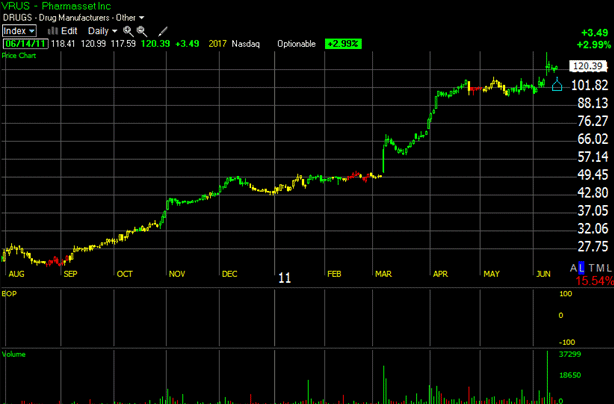
VRUS is a good example of stock with very high relative linearity currently. It is up 158% in last six months.
Stocks like VRUS are the kind of stocks ideal for swing trading. They allow you to put logical and close stops and make smooth moves.
One of the easiest ways to find stocks with relative linearity is by eyeballing top 300 or so stocks by 6 month or 3 month momentum. There is also a mathematical way to find stocks with relative linearity.
One of the ways to find relative linearity is by using Kaufman's Efficiency Ratio or Fractal Efficiency ratio. The Fractal Efficiency Ratio is described in detail in New Trading Systems and Methods by Perry Kaufman.
Fractal Efficiency ratio is derived by dividing the net change in price movement over n periods by the sum of all component moves, taken as positive numbers, over the same n periods. If the ratio approaches the value 1, then the movement is smooth, if the ratio approaches 0, then there is great inefficiency or chaos. So fractal efficiency basically is a measure of relative market speed to volatility, and can be used as a trading filter to avoid choppy or flat stocks.
To understand this better let's look at a stock price move for 60 days. Stock A makes 60 point move in 60 days. Each day the stock moves up exactly by 1 dollar. This would give an efficiency ratio of 1. Now say for stock B, it also moved 60 points in 60 days, but with higher volatility, some days up 3 points, some days down 2 points. The efficiency ratio would be lower as the denominator in the ratio will be large.
Now if you want to calculate the efficiency ratio in Telechart, you can try this modified scan for 60 days.
60 Day Efficiency Ratio
(C - C60) / (ABS(C - C1) + ABS(C1 - C2) + ABS(C2 - C3) + ABS(C3 - C4) + ABS(C4 - C5) + ABS(C5 - C6) + ABS(C6 - C7) + ABS(C7 - C8) + ABS(C8 - C9) + ABS(C9 - C10) + ABS(C10 - C11) + ABS(C11 - C12) + ABS(C12 - C13) + ABS(C13 - C14) + ABS(C14 - C15) + ABS(C15 - C16) + ABS(C16 - C17) + ABS(C17 - C18) + ABS(C18 - C19) + ABS(C19 - C20) + ABS(C20 - C21) + ABS(C21 - C22) + ABS(C22 - C23) + ABS(C23 - C24) + ABS(C24 - C25) + ABS(C25 - C26) + ABS(C26 - C27) + ABS(C27 - C28) + ABS(C28 - C29) + ABS(C29 - C30) + ABS(C30 - C31) + ABS(C31 - C32) + ABS(C32 - C33) + ABS(C33 - C34) + ABS(C34 - C35) + ABS(C35 - C36) + ABS(C36 - C37) + ABS(C37 - C38) + ABS(C38 - C39) + ABS(C39 - C40) + ABS(C40 - C41) + ABS(C41 - C42) + ABS(C42 - C43) + ABS(C43 - C44) + ABS(C44 - C45) + ABS(C45 - C46) + ABS(C46 - C47) + ABS(C47 - C48) + ABS(C48 - C49) + ABS(C49 - C50) + ABS(C50 - C51) + ABS(C51 - C52) + ABS(C52 - C53) + ABS(C53 - C54) + ABS(C54 - C55) + ABS(C55 - C56) + ABS(C56 - C57) + ABS(C57 - C58) + ABS(C58 - C59) + ABS(C59 - C60) + 0.001)
Stocks do not have a perfect efficiency reading of 1. Even a small anti trend move lowers the efficiency reading. The above formula scan will give you values between 1 to -1. If you sort by this scan, the higher ratio stocks will have smoother trends lower readings will show very volatile stocks. If market is going sideways you need to look at its Fractal Efficiency Ratio during its uptrend before correction.
My general observation is that smoother trends continue to be smooth and volatile trends continue to be volatile. Relative linearity is my most important criteria for eliminating stocks. If a stock does not have relative linearity, I do not even look at rest of the criteria and will not buy a breakout on it.
Kirk: That's very helpful Pradeep. It's interesting to me also that I find that new traders tend to seek out positions with a great deal of volatility while more experienced traders often do the exact opposite. You would think the exact opposite would occur.
As we begin the summer trading season, do you make any adjustments to your approach?
Pradeep: The summer season tends to be slow but if I find a stock with good linearity and momentum I will still be a buyer. But volume and liquidity are sometime problem so I risk smaller amounts in that case. I am fully engaged during the summer month as this market can turn to bullish side anytime and I want to be in on any big bull move.
Kirk: How do you determine an exit on both a profitable and unprofitable position?
Pradeep: By trial and error and past analysis of my trades I have found that the best exit is into strength. You should always sell a momentum stock into strength and not wait for it to hit stop. I operate on profit targets.
I am typically looking at 8 to 20% profit target on my swing trades and 40 to 50% target on my Episodic Pivots trade. I sell when stock reaches my profit objective. I sell in parts so most of the time I peel off positions in units of 1/4th.
One of the exit rules which have worked very well for me is to exit a position into 10% plus move after entry. Let us say I buy a stock today as swing trade and next day it goes up 10% I would exit it or exit at least 50 to 75% of my position into that unexpected bonanza. I have found most of the time such large moves fade.
I also exit my trades after 3 days if it does not move in intended direction after.
Kirk: At your site you offer two interesting tools: a trade size tool and a risk reward calculator. Can you share the basic principles behind both?
Pradeep: The trade size tool is a simple tool to calculate how many shares you should buy for 1% risk. This will enable you to properly manage your risk in every trade.
Let us say you want to buy a stock trading at 122 and your stop is 118 and you want to risk 1% of your 100000 portfolio on it. If you input these values in the calculator it will tell you, you can buy 250 shares and 30.5% of your account will be invested in that one position.

The Risk Reward calculator is another good tool to find out potential risk reward of a trade. It requires you to input your Entry, stop and target price and it gives you R:R. It can be accessed free by your members here.
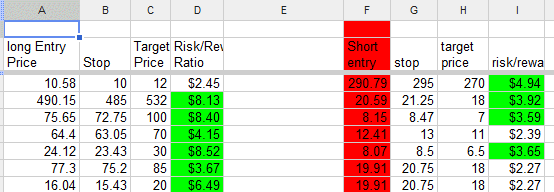
Besides that there are many other tools developed by members. One of the best one is a tool developed by a member for analyzing trade called Trade Logger. If you want to monitor your trading performance and figure out how to improve the performance the tool would just blow your mind.
Kirk: I think many will find these tools helpful Pradeep. Thank you.
In our last interview you emphasized that "methods trump markets." In other words, control the things under your control and let the market do what it is going to do. Over the past year since our last interview, has your strategy changed and/or improved in any specific way?
Pradeep: Yes since our last interview I have further refined and simplified my momentum based approach. Primarily I have reduced the period used for calculating momentum from 130 days to 65 days. Markets are faster and a shorter momentum period can help you find new trends faster.
I have also modified my 401K investing approach. The new Telechart version has mutual funds data. That is something which was not easily available before. Earlier I used to track my mutual funds using Google Finance. Now I have setup a complete entry and exit strategy using Telechart data.
Kirk: What do you think are your primary strengths and weaknesses as a trader?
Pradeep: My primary strength is skills in momentum and growth investing and market timing. I have the discipline to sit out bad periods for my style of investing.
Besides that my strength is ability to teach others how to trade and develop their own method.
I have many weaknesses. One of the key one is very few methods. Not having methods for non-trending periods and intraday trading. I do not have the patience to day trade.
Kirk: How have you learned to mitigate your weaknesses and focus on your strengths?
Pradeep: I am comfortable with my current style and strength. I stay with my methods and do not change timeframe constantly.
I am working on number of new short term strategies and pullback methods. Besides that my key focus currently is to grow my commodity and currency trading skills.
Kirk: Among your subscribers, what common mistakes do you typically see that we all need to learn to avoid?
Pradeep: The common mistakes most traders make in beginning stages are primarily driven by lack of market understanding and lack of self-efficacy. Traders are not clear about their time frame. They don't want to commit to a timeframe. They want to be day traders, swing traders, position traders and macro traders.
Even if they commit to a timeframe then they do not stick with one setup idea. They trade too many and ill-defined setups.
The other problem is many are influenced by financial media and do not do independent thinking.
Kirk: Well said and I see the same issues.
Are you still using IBD, Telechart, and Finviz as your primary tools?
Pradeep: Yes I continue to use those tools. Besides that as I pointed out earlier there are many tools developed by members which I use. One of the best tools is the one developed by Dan of Patient Fisherman. Bluefin is a tool developed by Dan in collaboration with me. It is primarily built for working people who cannot get access to scanning tools and do not have too much time for day to day trading analysis.
I have also been using the Google Finance data importing capability in Google Spreadsheet . It allows you to develop simple tools for position sizing and risk management.
Kirk: In our last interview you provided a nifty breakout screen. Care to share another scan you have found helpful?
Pradeep: Sure. This scan is for 401K mutual fund investors. Most 401Ks offer a choice of 15 to 25 mutual funds to select from. The scan below will find you mutual funds that are starting their uptrend and it will allow you to exit at right time.
Entry:
AVGC4/AVGC42 > 1.01 AND AVGC4.1/AVGC42.1 < 1.01 AND AVGC4.2/AVGC42.2 < 1.01 AND AVGC4.3/AVGC42.3 < 1.01 AND AVGC4.4/AVGC42.4 < 1.01 AND AVGC4.5/AVGC42.5 < 1.01 AND AVGC4.6/AVGC42.6 < 1.01 AND AVGC4.7/AVGC42.7 < 1.01 AND AVGC4.8/AVGC42.8 < 1.01 AND AVGC4.9/AVGC42.9 < 1.01 AND AVGC4.10/AVGC42.10 < 1.01
Exit:
AVGC4/AVGC42 < 1.01 AND AVGC4.1/AVGC42.1 > 1.01
To see how this works see the chart below of actual trade:

If you marry the scan with overall market timing it will allow you to capture big moves in your mutual funds.
Kirk: What advice would you give to others who are just starting to learn about the markets and trading?
Pradeep: The top 100 most important things to do if you are a beginner trader is not to lose your trading stake during learning phase. If you can learn without losing your capital then you will have several years of profit opportunities ahead of you. First priority should be to stay in the game.
The second important thing is to decide your timeframe. You cannot be a day trader and also swing trader and also position trader and also global macro trader.
Hunt for setups. All profitable traders focus on few trading setups. They specialize in those setups.
Go into depth in everything. For example, don't use stochastics or MACD if you don't know what it is and how it is calculated.
Focus on what has worked in last 100 years. Trading setups and methods have been more or less same for 100 years. 100 year ago people were still trading momentum, or growth or value. 100 years ago there were day traders, swing traders and position traders. For 100 years or more people have made money by buying breakouts, pullbacks or exhaustions. Master the basic setups.
Kirk: What suggestions and recommendations do you have for traders who trade on their own to incorporate some group and collaborative support?
Pradeep: For many years I was trading alone, I had no contact with other traders. Five years ago I started blogging and since then a community of similar minded traders has developed. Now I know over 2000 traders. I know people who trade different timeframe, different methods and different account sizes.
I highly recommend traders to develop a support group. It can help you expand your trading horizon. It helps you enhance your skills and helps you stay focused.
Kirk: Do you plan to take any time off from the markets this summer? Do you think traders need to take time to step back and take a break?
Pradeep: This summer I do not have plan for a break as I am not hitting my yearly goals currently. But vacations and holidays from trading are very helpful.
My best thinking and new method development happens on such vacations. But one must time holidays with market phases. Unfortunately last year my vacations coincided with major market move starts. If you miss out on those beginning moves it can ruin your year.
Kirk: When not trading, what do you do with your free time? What are some of your personal passions beyond the markets?
Pradeep: There is never a dull moment in life. I have many interests and hobbies and I constantly try new things.
This year I have been learning dancing. We are a group of dads from my daughters dancing school who have been training and performing together. Couple of months ago we performed a dance based on Greased Lightning at a vintage car show. We are also performing another dance next week in an annual dance function.
In few weeks I am going to participate in a 3 month fitness bootcamp. Besides that running, walking, cycling, and cooking are some of my other interests.
Kirk: Well, thank you Pradeep for another informative and helpful interview. As always, we all wish you the best and many profitable trades in the weeks and months ahead!
Are you serious about your trading?
If you are serious about your trading and want to build an enduring edge the Stockbee Member site might help you. Members tell me they have tried lot of things before coming to my site and it has offered them the most extensive and detailed methods to swing and position trade.
It is only for those who want to develop their own self sufficient trading method. It is not a stock picking service. It is service for you to build your own scans and trading method to have your own daily pick based on your method.
Be warned it will take you time to learn to trade. Learning to trade is difficult art and unless you are willing to spend months or years to perfect your strategy and also develop your mental edge you are unlikely to succeed in this game. Unless you understand that no site, no service, and no mentoring is going to work.
Why traders come to stockbee?
The member site is one of the most recommended site for learning to trade by other traders and bloggers. You will see no advertising, no hard marketing, no promotions, no free offers, no affiliate marketing, no incentive to other bloggers to promote the site, no constant twits self promoting the site, no free trial and no tall claims of making you instantly wealthy, and yet the site attracts new members everyday. Members come from all walks of life and all kinds of trading size and trading styles.
You will see that many trading bloggers have been using my market timing methods, scans , stock ranking lists and chart templates. They have developed their own methods based on my methods. Many paid newsletter site recommend my site to their subscriber for learning about trading and market.
Over the years thousands of traders have been members and those who benefited from the learning talk about the site to others or talk about the methods used and that is how new members learn about the site.
What will I learn in the members site?
The members site will give you in depth understanding to develop your own trading method. The emphasis is on making you self sufficient and confident of your own trading method and style.
As a member you will learn the basics of swing trading, momentum investing, growth investing and risk management.
You will learn about Stockbee Trend Intensity Breakouts method that uses momentum based swing trading to find 3 to 5 day swing trades for 8 to 40% profit.
You will learn about Stockbee Episodic Pivots Breakout method which uses Post Earnings Announcement Drift (PEAD) to find stocks that had a game changing earnings and that are likely to rally for 3 months to 12 months.
You will learn about Stockbee Dollar Breakout method that uses momentum, range expansion and swing trading approach to find 5 to 40 dollar moves in high priced stocks.
You will learn about Stockbee Lemonade Strategy for 401k which uses market timing and momentum to invest in 401k. You will get weekly update on how I am using the strategy on our 401k to do allocation decision.
You will learn about Stockbee Market Monitor method for market timing using breadth. It allows you to avoid risky periods in market and allows you to identify market turns. It is used for 401k allocation decisions.
You will learn about Stockbee Double Trouble method to find stock with confirmed upside momentum using anchored momentum and that are likely to continue their up move.
You will learn about Stockbee Night Time is Right Time method to find news catalyst based trade ideas for short term day trade and swing trade.
You will learn about Investor's Business Daily’s IBD 200 list and how it can be used to find swing trading candidates for explosive moves.
You will learn about Telechart 2000 and how to use it effectively to scan for swing and position trade ideas and to set up your 401k strategy.
You will learn about Jesse Livermore Range Breakout, Darvas Box setup, and many other member shared methods.
You will learn how to set up your own scans, select right kind of stocks, how to set up stops, when to enter , when to exit, how much to risk, how to track your trades and all other details about trading. You will learn about developing your own methods and not relying on others for trade ideas.
The site has hundreds of videos and trading methods and variation of methods. Members help each other in developing the methods and share actively their research and finding. A collaborative spirit allows you to get input from others on your trading ideas or problems.
The site gives you opportunity to interact with some of the most successful traders and learn from them about their trading methods. It is a vibrant community with members from different background and experience willing to help each other. The emphasis is on continuous learning and up gradation of market knowledge and setup knowledge. The members range from hedge fund employees, financial advisers, active swing traders, investors and new traders.
If you are looking to develop your own trading strategy the membership site might be for you. You have to be willing to put in the effort to build your own method. There are no silver bullets offered on members site. Every method, every scan, every nuance is detailed and all possible help is offered to design your own method.
Do you have a trial?
If you are just looking for trial you are better off trying thousands of other trading sites that offer free trial or one month trial and offer you promise of riches.
It is for those who are ready beyond the trial phase and ready to put serious months or years of efforts to learn to trade on their own. It is for those who want to learn to find their own fish.
The free blog has all the details about the methods I trade and if you go through the posts highlighted in the sidebar you will learn about them.
How can I become a member?
To sign up go to www.stockbee.biz and follow the sign up process. The site uses Paypal for payment processing.


