
Investors follow latest fashions. Recently a book on Exchange Traded Funds ( ETF) promoting 6 month relative strength as primary way to build ETF portfolio has been released. Suddenly people are looking for ways to rank ETF by 6 month momentum.
While a momentum based approach works on ETF, the real art is in the nuances involved in making it work. If you don't understand how momentum works and how to design strategies for entering momentum based vehicles at right time, you will be the last fool to buy them before they reverse. When you use momentum based ranking to invest in ETF top 10 ranked ETF can also be the most extended ETF and just near their top. Without understanding that if you start dabbling in momentum investing you will soon be disillusioned and be searching for next hot book on ETF.
Momentum rankings are very easy to derive. Anyone with basic maths skills and free data sources like Google spreadsheet or excel can easily develop their own ranking method. Momentum or relative strength rankings are arrived at by calculating Rate of Change or ROC.There are many ways to calculate ROC and each of the ways can give you slightly different ranking and each approach has some benefits or short comings.
The easy way to calculate relative strength is by calculating 6 month price change and ranking ETF by it. In Telechart this can be done easily using Price Percent Change 26-Week which is a System sort criteria. The Telechart pcf for it is: 100*(c-c126)/c126.
Another better way to rank ETF by 6 month relative strength is by calculating ROC as a ratio of price to six month average price. The advantage of this approach is it uses average price of last 6 month as against a one price point of six month ago price in earlier ROC calculation. In Telechart this is easy to do using a PCF like c/avgc126.
In addition to ROC rank you must also use some kind of liquidity filter to eliminate ETF with low trading volume. Let us say you want only to focus on ETF trading 100000 plus daily to avoid slippage. Then you can use a sort to eliminate such ETF using a Telechart pcf like minv3>=1000.
Using both these criteria I created a list of 25 ETF that are highest ranked by momentum:
AGQ,Proshares Ultra Silver
BRF,Market Vectors Brazil Small-Cap
DAG,DB Agriculture Double Long ETN
DBS,PowerShares DB Silver Fund
DGP,DB Gold Double Long ETN
ECH,iShares MSCI Chile Index Fund ETF
EDC,Direxion Daily Emerging Markets Bull 3x Shares
EPI,WisdomTree India Earnings Fund ETF
EPU,iShares MSCI All Peru Capped Index Fund
EWD,iShares MSCI Sweden Index Fund ETF
EZA,iShares MSCI South Africa Index Fund ETF
FDN,First Trust Dow Jones Internet Index Fund ETF
FRN,Claymore/BNY Mellon Frontier Markets ETF
GDXJ,Market Vectors Junior Gold Miners ETF
HAO,Claymore/Alphashrs 2 Sm Cap
IDX,Market Vectors Indonesia Index
INP,iPath MSCI India Index ETN
PIE,PowerShares DWA Emerging Markets Technical Leaders Portfolio ETF
RJA,ELEMENTS Linked to the Rogers International Commodity Index - Agriculture Total Return ETN
SIVR,ETFS Silver Trust
SLV,iShares Silver Trust ETF
THD,iShares MSCI Thailand Investable Market Index Fund ETF
TQQQ,ProShares UltraPro QQQ
TUR,iShares MSCI Turkey Investable Market Index Fund ETF
UYM,ProShares Ultra Basic Materials
While a momentum based approach works on ETF, the real art is in the nuances involved in making it work. If you don't understand how momentum works and how to design strategies for entering momentum based vehicles at right time, you will be the last fool to buy them before they reverse. When you use momentum based ranking to invest in ETF top 10 ranked ETF can also be the most extended ETF and just near their top. Without understanding that if you start dabbling in momentum investing you will soon be disillusioned and be searching for next hot book on ETF.
Momentum rankings are very easy to derive. Anyone with basic maths skills and free data sources like Google spreadsheet or excel can easily develop their own ranking method. Momentum or relative strength rankings are arrived at by calculating Rate of Change or ROC.There are many ways to calculate ROC and each of the ways can give you slightly different ranking and each approach has some benefits or short comings.
The easy way to calculate relative strength is by calculating 6 month price change and ranking ETF by it. In Telechart this can be done easily using Price Percent Change 26-Week which is a System sort criteria. The Telechart pcf for it is: 100*(c-c126)/c126.
Another better way to rank ETF by 6 month relative strength is by calculating ROC as a ratio of price to six month average price. The advantage of this approach is it uses average price of last 6 month as against a one price point of six month ago price in earlier ROC calculation. In Telechart this is easy to do using a PCF like c/avgc126.
In addition to ROC rank you must also use some kind of liquidity filter to eliminate ETF with low trading volume. Let us say you want only to focus on ETF trading 100000 plus daily to avoid slippage. Then you can use a sort to eliminate such ETF using a Telechart pcf like minv3>=1000.
Using both these criteria I created a list of 25 ETF that are highest ranked by momentum:
AGQ,Proshares Ultra Silver
BRF,Market Vectors Brazil Small-Cap
DAG,DB Agriculture Double Long ETN
DBS,PowerShares DB Silver Fund
DGP,DB Gold Double Long ETN
ECH,iShares MSCI Chile Index Fund ETF
EDC,Direxion Daily Emerging Markets Bull 3x Shares
EPI,WisdomTree India Earnings Fund ETF
EPU,iShares MSCI All Peru Capped Index Fund
EWD,iShares MSCI Sweden Index Fund ETF
EZA,iShares MSCI South Africa Index Fund ETF
FDN,First Trust Dow Jones Internet Index Fund ETF
FRN,Claymore/BNY Mellon Frontier Markets ETF
GDXJ,Market Vectors Junior Gold Miners ETF
HAO,Claymore/Alphashrs 2 Sm Cap
IDX,Market Vectors Indonesia Index
INP,iPath MSCI India Index ETN
PIE,PowerShares DWA Emerging Markets Technical Leaders Portfolio ETF
RJA,ELEMENTS Linked to the Rogers International Commodity Index - Agriculture Total Return ETN
SIVR,ETFS Silver Trust
SLV,iShares Silver Trust ETF
THD,iShares MSCI Thailand Investable Market Index Fund ETF
TQQQ,ProShares UltraPro QQQ
TUR,iShares MSCI Turkey Investable Market Index Fund ETF
UYM,ProShares Ultra Basic Materials
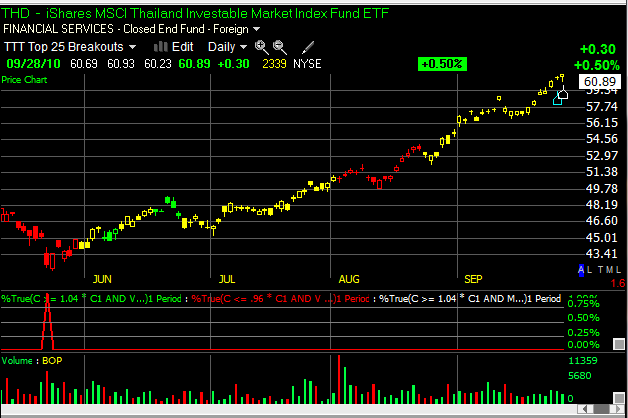
The top 3 ETF by 6 month momentum or relative strength currently are:
DAG DB Agriculture Double Long ETN

AGQ Proshares Ultra Silver

THD ishares MSCI Thailand Investable Market Index funds
Before you use a momentum or relative strength based approach to invest in ETF, mutual funds or stocks you should spend sometime thoroughly understanding the concept behind momentum and how it works, why it works, when it works, what are the risk involved in using it and so on. If you do not have that conceptual understanding of momentum , you can do great damage to to your account by buying stocks , ETF or mutual funds exactly at wrong time.
If you are serious about enhancing your understanding of relative strength then I suggest you read a good book on relative strength by Michael Carr . It is one of the best book on that topic. I have written a review of it when it came out in August 2008, if you see the comments on that post the author has also commented on the post. You can see the review below:
. It is one of the best book on that topic. I have written a review of it when it came out in August 2008, if you see the comments on that post the author has also commented on the post. You can see the review below:8/27/2008
Smarter Investing In Any Economy- The Definitive Guide to Relative Strength Investing by Michael Carr

Smarter Investing In Any Economy- The Definitive Guide to Relative Strength Investing by Michael Carr
The book as name suggest goes in to details about using Relative Strength to design a trading strategy. Relative strength based strategies are one of the ways to exploit the momentum anomaly. Relative strength strategies aim to find strongest or weakest stocks, ETFs, or sectors in any market environment and to trade them on long or short side till they maintain there relative strength. Well formulated relative strength based strategies keep you on the right side of market.
The book goes in to details of various ways to rank stocks. Formulas for calculating relative strength using absolute difference, normalised ROC, moving averages, front or back weighted ROC, and standard deviation are detailed.
In the next section the author demonstrates ways to build trading strategy using Relative strength. He goes in to issues like:
- What vehicles to buy using Relative Strength
- What time frames for relative strength are ideal
- When should you buy and sell
- How should you manage your risk
The author provides a researched strategy using the relative strength. Various application of relative strength for stocks, etf, mutual funds and futures are discussed , to provide further ideas for investors.
Some of the most successful trading methods in the market are based on relative strength . It is one of the proven methods in the market that works. This book provides a good guide to investors interested in learning and applying about relative strength based strategies.
The book certainly is not "The Definitive Guide to Relative Strength Investing " because it is very narrowly focused on one trading system application of relative strength. It could have done a much better job of illustrating many more relative strength based approaches. The first chapter in the book is the worst, it never defines relative strength properly and spends more time trying to repudiate momentum investing, when in fact the entire rational of relative strength investing is based on stock momentum.
In spite of some reservations, this is one of the best books out of 70-80 books on trading I have read so far this year. I highly recommend this book because it contains ideas and concept which can make you money.
Are you serious about your trading?
If you are serious about your trading and want to build an enduring edge the Stockbee Member site might help you. Members tell me they have tried lot of things before coming to my site and it has offered them the most extensive and detailed methods to swing and position trade.
It is only for those who want to develop their own self sufficient trading method. It is not a stock picking service. It is service for you to build your own scans and trading method to have your own daily pick based on your method.
Be warned it will take you time to learn to trade. Learning to trade is difficult art and unless you are willing to spend months or years to perfect your strategy and also develop your mental edge you are unlikely to succeed in this game. Unless you understand that no site, no service, and no mentoring is going to work.
Why traders come to stockbee?
The member site is one of the most recommended site for learning to trade by other traders and bloggers. You will see no advertising, no hard marketing, no promotions, no free offers, no affiliate marketing, no incentive to other bloggers to promote the site, no constant twits self promoting the site, no free trial and no tall claims of making you instantly wealthy, and yet the site attracts new members everyday. Members come from all walks of life and all kinds of trading size and trading styles.
You will see that many trading bloggers have been using my market timing methods, scans , stock ranking lists and chart templates. They have developed their own methods based on my methods. Many paid newsletter site recommend my site to their subscriber for learning about trading and market.
Over the years thousands of traders have been members and those who benefited from the learning talk about the site to others or talk about the methods used and that is how new members learn about the site.
What will I learn in the members site?
The members site will give you in depth understanding to develop your own trading method. The emphasis is on making you self sufficient and confident of your own trading method and style.
As a member you will learn the basics of swing trading, momentum investing, growth investing and risk management.
You will learn about Stockbee Trend Intensity Breakouts method that uses momentum based swing trading to find 3 to 5 day swing trades for 8 to 40% profit.
You will learn about Stockbee Episodic Pivots Breakout method which uses Post Earnings Announcement Drift (PEAD) to find stocks that had a game changing earnings and that are likely to rally for 3 months to 12 months.
You will learn about Stockbee Dollar Breakout method that uses momentum, range expansion and swing trading approach to find 5 to 40 dollar moves in high priced stocks.
You will learn about Stockbee Lemonade Strategy for 401k which uses market timing and momentum to invest in 401k. You will get weekly update on how I am using the strategy on our 401k to do allocation decision.
You will learn about Stockbee Market Monitor method for market timing using breadth. It allows you to avoid risky periods in market and allows you to identify market turns. It is used for 401k allocation decisions.
You will learn about Stockbee Double Trouble method to find stock with confirmed upside momentum using anchored momentum and that are likely to continue their up move.
You will learn about Stockbee Night Time is Right Time method to find news catalyst based trade ideas for short term day trade and swing trade.
You will learn about Investor's Business Daily’s IBD 200 list and how it can be used to find swing trading candidates for explosive moves.
You will learn about Telechart 2000 and how to use it effectively to scan for swing and position trade ideas and to set up your 401k strategy.
You will learn about Jesse Livermore Range Breakout, Darvas Box setup, and many other member shared methods.
You will learn how to set up your own scans, select right kind of stocks, how to set up stops, when to enter , when to exit, how much to risk, how to track your trades and all other details about trading. You will learn about developing your own methods and not relying on others for trade ideas.
The site has hundreds of videos and trading methods and variation of methods. Members help each other in developing the methods and share actively their research and finding. A collaborative spirit allows you to get input from others on your trading ideas or problems.
The site gives you opportunity to interact with some of the most successful traders and learn from them about their trading methods. It is a vibrant community with members from different background and experience willing to help each other. The emphasis is on continuous learning and up gradation of market knowledge and setup knowledge. The members range from hedge fund employees, financial advisers, active swing traders, investors and new traders.
If you are looking to develop your own trading strategy the membership site might be for you. You have to be willing to put in the effort to build your own method. There are no silver bullets offered on members site. Every method, every scan, every nuance is detailed and all possible help is offered to design your own method.
Do you have a trial?
If you are just looking for trial you are better off trying thousands of other trading sites that offer free trial or one month trial and offer you promise of riches.
It is for those who are ready beyond the trial phase and ready to put serious months or years of efforts to learn to trade on their own. It is for those who want to learn to find their own fish.
The free blog has all the details about the methods I trade and if you go through the posts highlighted in the sidebar you will learn about them.
How can I become a member?
To sign up go to www.stockbee.biz and follow the sign up process. The site uses Paypal for payment processing.

1 comment:
Great post and thanks for sharing the book reference. I personally like ranking ETFs by recent gain divided by their volatility - essentially the Sharpe or Sortino ratio. I look to find the ones with the smoothest uptrend.
Best regards. Keep up the great work!
Post a Comment